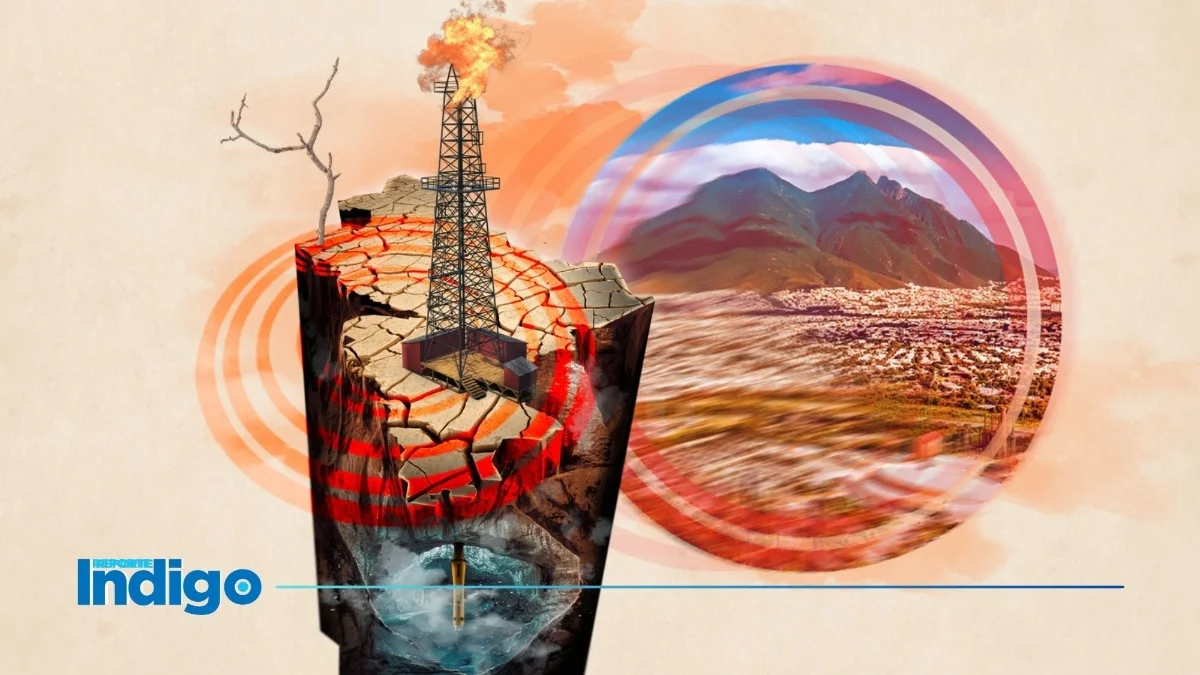

The possible return of fracking to the state raises concerns over the seismic risk it entails and the millions of liters of water it requires, in a state facing a structural water shortage.
While the federal government has once again opened the door to exploration for unconventional gas to reduce its dependence on natural gas from the United States, the territory of Nuevo León could experience impacts resulting from excessive water use, which is scarce in the state, as well as the possibility of earthquakes associated with fracking.
The state could bear the environmental cost of one of the alternatives that the federal government has once again placed on the table, potentially turning northern Mexico — and particularly Nuevo León — into a testing ground for an industry that has been questioned for years.
In this regard, activist Liliana Flores Benavides warned about seismic risks associated with the practice. In August, a series of seismic movements was recorded in three municipalities: an earthquake in Ciénega de Flores on August 5, two others in Linares, and another in Santa Catarina the previous week, all below magnitude 3.9.

Meanwhile, the administration of President Claudia Sheinbaum is advancing studies to determine the feasibility of extracting unconventional gas through hydraulic fracturing.
“It can be warned, in any case, that there could be an increase in seismic activity in Nuevo León,” Flores Benavides said. However, she clarified that there is no evidence to establish that the recent earthquakes were caused by fracking.
In fact, the experimental wells in the municipality of Los Ramones are currently out of operation, the activist clarified.
However, she said the precedent is sufficient to demand something that, in her view, should be mandatory before reopening the door to this activity: precaution, independent research and transparency.
“Nuevo León is a land of minor seismic activity, but there is seismic activity that can be intensified by fracking. So, those earthquakes happened, but we cannot say they were caused by fracking, because the only wells were shut down a while ago, during López Obrador’s administration.”
“Former President López Obrador said there should be no fracking, but he never moved even a millimeter to modify the laws and ban it. The country’s current laws allow it. In other words, deep down, he did want fracking to happen, because they never did anything, despite having an extraordinary majority in the Senate and the Chamber of Deputies,” she explained.
The door that has reopened
The discussion over fracking officially returned to Mexico in April, when President Claudia Sheinbaum announced that her government would study the use of unconventional deposits to reduce dependence on imported gas.
The government’s argument is difficult to ignore: approximately 75 percent of the natural gas consumed by Mexico currently comes from the United States. In addition, a significant portion of that fuel is used for electricity generation.
However, the government’s own strategy recognizes a paradox: even if Mexico exploited its unconventional deposits, dependence on the United States would not disappear immediately.
For Flores Benavides, this does not justify transferring the environmental risk to Mexican territory. “That does not solve the underlying problem and does expose us to a major risk: groundwater contamination and seismic activity.”
Excessive water use, another problem
Hydraulic fracturing requires injecting large quantities of pressurized fluid to break the rock and release the gas trapped inside it.
The committee of specialists convened by the federal government acknowledged that a fracturing well can require tens of millions of liters of water.
Regarding this, Liliana Flores Benavides stated that an activity with such a high demand for water cannot be proposed in a region where water is a structural problem.
“Using nine to 19 million liters of water per well is too much. There are water problems. We have not solved the water problems here; the water problems were eased by Hurricane Alex, when the dams filled up, but the underlying problem has not been solved.”
“And then there is El Cuchillo Dam, where they keep taking water to comply with international treaties, although we are not included. Now they say it is because farmers somewhere do not have water and they are going to send it to them. The water problem has not been solved. Imagine the Burgos Basin, the northern part of the state, affected by all of that, plus seismic activity in a state where seismic activity is light and infrequent,” she said.
Although the possibility of using salt water instead of freshwater for fracking is being considered, Flores Benavides said this alternative does not resolve all the concerns.
“The only thing it removes is the use of drinking water instead of salt water,” she said. Her argument is that the risks are not reduced solely by changing the source of the water used.
There is also the management of flowback water, the chemicals used during the process, waste, and the possibility of affecting soil and subsoil, potentially contaminating groundwater.
The government, meanwhile, maintains that new technologies could reduce the environmental impact through the use of less-polluting substances and water recycling.
Source: reporteindigo