
The column by Paul Schmidt-Troschke marks an exclusive World Cup partnership with the Monterrey Daily Post and The Guadalajara Post in which Schmidt-Troschke and the ‘World Cup etc’ international reporting team will be contributing exclusive World Cup coverage for both the YT and the SMT. ‘World Cup etc’ can be found across all good podcast providers.
The Mexican Football Federation (FMF) has announced and already launched a last-minute campaign against homophobic chants in Mexican stadiums as the start of the 2026 World Cup is edging closer by the day. And the only unexpected thing is the late announcement of such a campaign, because Mexican football has a decades-long problem with homophobic chants in its stadiums.
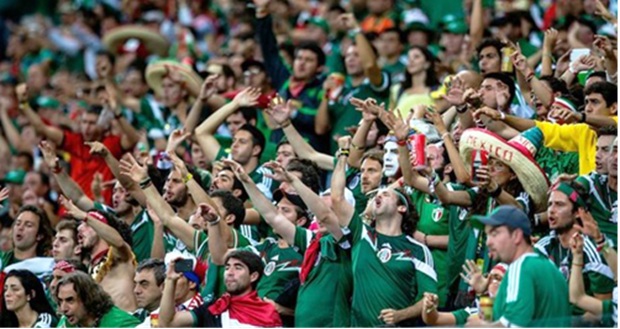
But first, in general, the Mexican football fan experience is absolutely amazing, as I have been fortunate enough to live it through numerous times already. Not only are the stadium atmosphere and the accompanying culinary experiences are great, but Mexican fan culture rose to global fame by making the “Mexican Wave” the countries signature group celebration in which every single fan in the stadium becomes part of a choreographed wave flowing around the ranks. This tradition goes back to the 1986 world cup, Mexico’s second time hosting the tournament, but then, starting in the 2000s, an upcoming group chant started to rival the Mexican wave in its popularity, but for all the wrong reasons, unfortunately.
Whenever the rival goalkeeper is about to take a goal kick, fans started to voice a “ehhhhhhh” – and once the ball flew, a “PUTOOOOO” followed. For those without any knowledge of the Spanish language, “puto” can mean many things, all bad, but in this context, it is translated to something like “gay prostitute”. As easy as it is to identify the issue with this chant, as difficult it is to fight its usage. And even if you do not hear it in every match, it seems to be an integral part of the Mexican fan-chant repertoire.

The problem is so deeply rooted that the FMF has already been punished more than 18 times since 2014 for homophobic chants by Mexican national team football fans. The forms of punishment applied by FIFA range from official warnings, small monetary fines, larger repeat-offender fines over match stoppages and early match endings, to even partial or full stadium closures and threats of point deductions. While the fines usually do not exceed the $150.000USD mark, the usage of closed-door matches in 2021 is quite a drastic measure, which still could not lead to any measurable change in fan behaviour, at least not among a meaningful number of fans.
The FMF does not come across well either, since any implementation of measures against the chant only came into fruition after FIFA enacted multiple disciplinary actions against the governing body of Mexican football, which shows that the issue at heart, namely the fight against homophobia, was not really a true intent to begin with. And the kind of action plan FIFA developed and forced upon the FMF to use in the Liga MX, the Mexican first division, is unrivalled worldwide. It entails a 3-step approach that the referee must follow when he hears the chant in a match.
The first measure in the so-called “Anti-Discrimination Protocol” causes the referee to stop the match and issue a warning to the fans, while stadium and security staff tries to identify and eject the offenders and public announcements are made demanding the fans to quit the chant. After a couple of minutes, the match restarts. If the chant continues, the first official then suspends the match and sends the players into their locker rooms, followed by a cooling-off period, after which the game is continued. And if all that did not help and fans continue with the offense, the referee has the authority to permanently abandon the game.
Further, Liga MX introduced a mandatory digital Fan ID system. Fans must register and scan a QR code along with identification to enter stadiums, a system that is backed by facial recognition technology. This removes fan anonymity and allows authorities to track down individuals yelling the slur. And since the league operates on a zero-tolerance policy for identified offenders, any fan caught and ejected for shouting the chant faces a five-year ban from attending matches in any Mexican soccer stadium. But If a club’s fanbase repeatedly violates the rules and triggers the match protocol, the FMF punishes the club directly by forcing it to play future home matches in completely empty stadiums.
In the case of La Liga MX, the protocol showed its effectiveness already. Since clubs are above all economic undertakings, the threat of a complete loss of ticket revenue gave individual clubs the opportunity to solve the issue for themselves, which led to the implementation of some very productive and creative approaches.
For example, Liga MX club “Tigres” based in Monterrey made the following offer to its fans: Quit the chant for a single match, and the club will pay for the renovation of an elementary school in the metropolitan area of Monterrey. The fans’ reaction: Say less.
The initiative turned out to be an enormous success, benefiting everybody, with 6 schools being renovated in cooperation with businesses and fan volunteers. More than 1000 children can now learn under improved conditions. And the club was not only granted its original demand but got rewarded with a massive PR victory as well. If that’s not a role-model solution, I am a monkey’s uncle.
Paul Schmidt-Troschke for Mexico Daily Post

Paul Schmidt-Troschke is a German independent journalist, currently based in northern Mexico, specializing in international sports and their relationship to politics and society. He is the co-host of the “World Cup