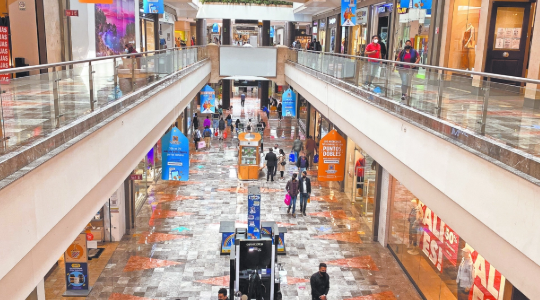

Mexico City and its Metropolitan Area concentrate the largest amount of commercial space in the country, but they offer less retail space per resident than Monterrey and Guadalajara. Even so, their shopping centers maintain the highest occupancy levels among Mexico’s main markets.
According to the real estate consulting firm SiiLA, the region has 16 square meters (m²) of gross leasable area (GLA) of retail space for every 100 residents, compared with 25 m² in the Monterrey Metropolitan Area and 17 m² in Guadalajara.
Despite this lower availability of retail space, shopping centers in Mexico City reached a 94% occupancy rate by the end of the first quarter of 2026, compared with 91% in Monterrey and 92% in Guadalajara.
Challenges for New Projects

This performance comes in a challenging environment for the sector. Shopping centers have maintained a steady flow of visitors despite economic uncertainty, but the development of new projects has slowed in recent years.
According to SiiLA, approximately 300,000 m² of new retail space is expected to be added during the 2025–2026 period. This volume would triple the amount delivered during the previous two years and marks the beginning of a recovery in development activity.
Despite this rebound, the shortage of land available for large-scale developments in urban areas, along with the lengthy process of obtaining construction permits, remains one of the industry’s main challenges.
Investment Is Concentrated Outside Mexico City
The differences between markets are also reflected in the destination of new investments. According to the Mexican Association of Real Estate Developers (ADI), $498.9 million will be invested in the construction of shopping centers across Mexico during 2026.
Of the total investment, 25% will be allocated to the state of Nuevo León, which is expected to add approximately 133,000 square meters of new retail space.
Jalisco will receive 3.7% of the investment, equivalent to 25,639 square meters, while Mexico City will account for only 1.8% of the total, adding 14,768 square meters of new commercial space.
Even with a slower pace of construction, existing shopping centers continue to experience strong demand from both retailers and consumers, particularly those located in established commercial corridors.
Less Retail Space, Fewer Operators
The difference is also reflected in the number of companies operating shopping centers. While Monterrey has approximately 25 retail operators per 100,000 residents and Guadalajara has about 18, Mexico City has only nine.
“This means that a larger portion of the population shares the same base of retail operators,” SiiLA explained.
According to the consulting firm, the relationship between retail space and population is one of the main indicators used to identify development opportunities. Beyond the existing inventory, this indicator helps evaluate the potential demand for retail properties.
Source: eleconomista