
The column by Paul Schmidt-Troschke marks an exclusive World Cup partnership with The Guadalajara Post and the Monterrey Daily Post in which Schmidt-Troschke and the ‘World Cup etc’ international reporting team will be contributing exclusive World Cup coverage for both websites. ‘World Cup etc’ can be found across all good podcast providers.
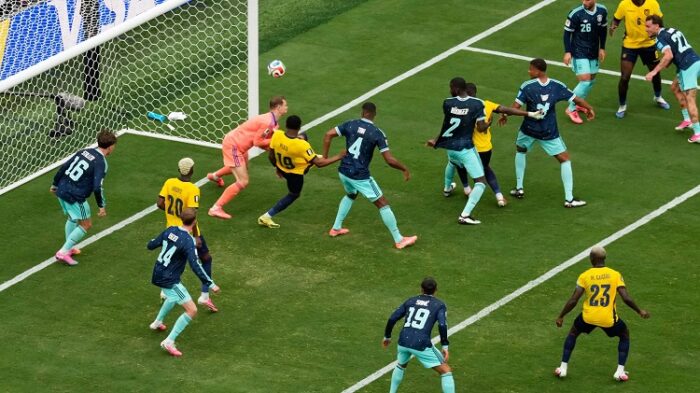
For German football, this year’s world cup exit can only be described as a total disaster, and I am neither the only one nor is it an exaggeration when I say that the round of 32 match against the unbeatable football powerhouse of Paraguay was the worst performance I have ever seen from a German national team in a world cup.
But how could it get so far? Here is the autopsy answering exactly that question:
A staggering statistic to begin with: Germany’s last match without conceding a goal was the final in 2014, that fact by itself tells its own story about the enormous and structural weakness in Germany’s defence.
One of the most obvious points of failure was the inability to effectively counter an opposing team using a deep block defence, something which we have seen a lot of especially underdog teams using in this 2026 world cup. For Germany, this was one of the biggest issues in all of the games after the first match against Curacao, namely in the games against the Ivory coast, Ecuador and Paraguay. And while the team did not have a strategy, neither did individual players. And that is one of the most damming conclusions from this world cup, that neither as a team, nor on any individual level, Germany was able to stand out in any category. The whole squad was lacking everything as whole as well as individually. For the fifth most valuable team in this world cup coming in just under 1 billion € total and with players like Jamal Musiala or Florian Wirtz being worth more than 100m€ each, this performance is an indictment across all categories.

While the players failure represents only one side of the equation, coaching is the other. And that was arguably even more consequential.
German coach Julian Nagelsmann has experienced the biggest downfall of a German national team coach in decades, and he truly earned it, since he ignored all warnings, and that quite arrogantly. When it came to the nomination of players for the national team, Nagelsmann declared the merit principle to be his best tool for choosing the best players. But when the list of players was released a couple of weeks before the tournament, there was not too much left of said merit principle. The second-best attacker of the last season in the Bundesliga, Deniz Undav, was not among the starting 11 for the first three matches. But still, a skilled communicator could have explained the situation quite well, but Julian Nagelsmann does not show such traits. Instead, he reacted annoyed.
And for a coach who sets out to have a clear plan for everything, he made surprisingly many changes and decisions which completely contradict his own words. The most prominent case of course was the backstabbing of Germany’s number 1, Oliver Baumgart, who just days after the season ended got the message that retired Manuel Neuer will make a surprising return.
But lastly, also the best coach in the world would have had his trouble to create a successful German team for this tournament, because German football is struggling with a deep structural crisis. It all starts with expectations from both fans and the German FA itself. We understand us as still being a world class footballing nation, which we are obviously not anymore. We can get there again, but only with a clear plan and managed expectations. Instead of thinking that we can realistically win everything every time, we must understand how past German success came into fruition.
A team worthy of winning the world cup or European championship needs to be built over time. The most important thing is not winning but seeing results of constant improvement over time. As Germany was not among the top 16 teams in the past three world cups, this has now ultimately achieved what was necessary: A collective realisation that things have to change fundamentally and we are not anymore who we used to think we are.
When asked in 2024 after Germany was kicked out by Spain in the quarterfinals of the Euros, Julian Nagelsmann said that the only thing which makes him sad is that we now must wait two years before we will win the World Cup. I think that we have to wait much longer for that to happen again.
By Paul Schmidt–Troschke for Mexico Daily Post

Paul Schmidt-Troschke is a German independent journalist, currently based in northern Mexico, specializing in international sports and their relationship to politics and society. He is the co-host of the “World Cup etc” and “World Sports etc” podcasts, available across all podcast platforms.